
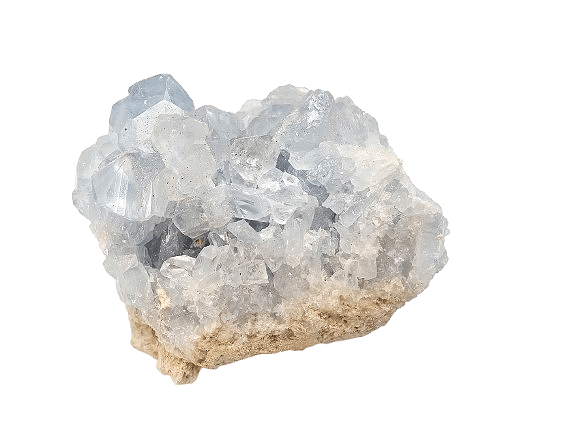




Celestite Cluster E – Natural Madagascar Blue Crystal Cluster 198g
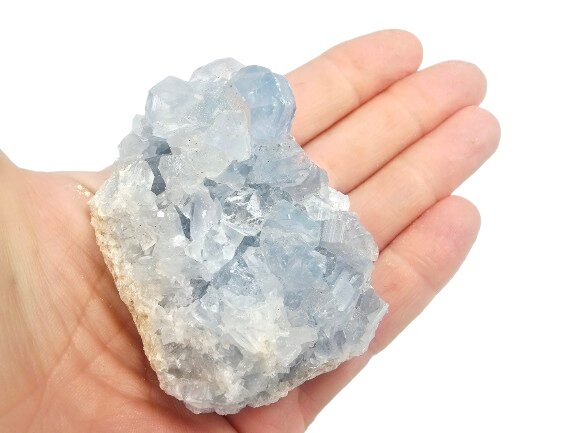
This natural Celestite cluster from Madagascar weighs approximately 198g and measures around 6.5 x 5.5cm, giving it a noticeably more substantial presence while still being an easy size to display.
Celestite is treasured for its naturally occurring crystal clusters and characteristic blue colouring, but there’s far more to this mineral than its peaceful appearance suggests. Its proper mineral name is celestine, its name literally has a “heavenly” origin, and one of its key elements is responsible for producing brilliant red fireworks.
Browse more specimens in our Celestite collection.
Product Details
- Crystal: Natural Celestite / Celestine
- Form: Natural crystal cluster
- Size: Approx. 6.5 x 5.5cm
- Weight: Approx. 198g
- Origin: Madagascar
- Individual natural mineral specimen
- Includes a crystal meaning card
What Is Celestite?
Celestite is the name commonly used in the crystal and gemstone world for the mineral celestine, a naturally occurring strontium sulphate with the chemical formula SrSO₄.
Although Celestite can occur in several colours, including colourless, white and grey, it’s the beautiful blue material that has made the mineral such a favourite amongst crystal collectors.
Rather than being polished into a predetermined shape, clusters allow you to see something closer to the way the mineral naturally develops, with multiple crystal surfaces forming together as one specimen.
If natural crystal formations are your weakness, have a look through our Crystal Clusters collection.
Did You Know? Celestite Is Named After the Heavens
The name celestine comes from the Latin caelestis, meaning celestial or heavenly.
The name was inspired by the delicate sky-blue colouring seen in classic specimens, making this one mineral whose name really does suit its appearance.
But Celestite has another, much less serene connection.
It contains strontium, and strontium compounds are famous for producing an intense crimson-red flame. They’re used to create brilliant reds in fireworks and signal flares.
So tucked inside a mineral renowned for its calm blue colouring is an element associated with some of the brightest reds in a fireworks display.
Blue crystal. Red fireworks. Celestite has range.
Why Madagascar Celestite Is So Recognisable
Madagascar is particularly well known amongst mineral collectors as a source of attractive Celestite specimens and clusters.
The country has produced the blue Celestite that many people now immediately associate with the mineral, and Madagascar specimens have become familiar sights in mineral collections around the world.
For collectors who enjoy keeping track of where their specimens originated, having a known locality adds another interesting piece to the mineral’s story.
You can explore more natural and polished minerals in our broader Crystals collection.
Celestite Meaning & Traditional Associations
Within contemporary crystal traditions, Celestite is commonly associated with peace, serenity, communication and spiritual awareness.
Other popular associations include:
- Calm
- Reflection
- Meditation
- Intuition
- Tranquillity
- Communication
- Spiritual awareness
- Inner peace
Its peaceful reputation, combined with its blue colouring, makes Celestite a popular choice for bedside tables, meditation spaces and quieter areas of the home.
Celestite is most commonly associated with the throat chakra and is also frequently connected with the third eye and crown chakras.
The throat connection reflects themes around communication and expression, while the third eye and crown associations are traditionally linked with intuition, reflection and spiritual awareness.
Look at a Cluster from More Than One Direction
Crystal clusters deserve to be viewed differently from polished stones.
Instead of having one obvious “front”, the individual crystal growth can make different angles interesting. Try rotating the cluster slowly and looking down into it as well as viewing it from the sides.
Display tip: A small raised stand can work beautifully for clusters because it allows more light to reach the crystal surfaces while lifting the specimen above smaller tumbles and palm stones around it.
At approximately 6.5 x 5.5cm and 198g, this piece is substantial enough to hold its own amongst other specimens without needing a huge amount of shelf space.
Caring for Celestite
Celestite looks solid but deserves relatively gentle handling.
It has a Mohs hardness of approximately 3 to 3.5, making it considerably softer than Quartz. Harder minerals can scratch it, while exposed crystal edges can be damaged by knocks.
For ordinary dusting, use a very soft, dry brush. Avoid abrasive cleaners, harsh chemicals and vigorous scrubbing.
When moving a cluster, support the solid body or base rather than grabbing an individual crystal.
It’s also worth considering where you store it. Don’t throw Celestite loose into a box with Quartz points or other harder minerals where the specimens can knock and rub against each other.
Frequently Asked Questions
Where does this Celestite come from?
This natural Celestite cluster comes from Madagascar, a particularly well-known source of collectable blue Celestite specimens.
How large is this Celestite cluster?
It measures approximately 6.5 x 5.5cm and weighs around 198g, giving it a substantial feel without requiring a large display area.
Are Celestite and Celestine the same mineral?
Yes. Celestine is the recognised mineral name, while Celestite is an alternative name widely used by crystal sellers and collectors.
What is Celestite traditionally associated with?
Within contemporary crystal traditions, Celestite is commonly associated with peace, calm, serenity, communication, meditation and spiritual awareness.
Which chakras are associated with Celestite?
Celestite is commonly connected with the throat chakra and is also frequently associated with the third eye and crown chakras.
Why should Celestite be handled carefully?
Celestite has a Mohs hardness of only around 3 to 3.5. Its crystal surfaces can therefore be scratched by harder minerals, while exposed areas of a cluster may be vulnerable to knocks.
Pairs Well With
- Amethyst
- Clear Quartz
- Selenite
- Moonstone
- Blue Calcite
- Other natural crystal clusters
Perfect For
- Celestite collectors
- Madagascar mineral collections
- Blue crystal lovers
- Natural crystal cluster displays
- Mineral collectors
- Meditation spaces
- Throat, third eye and crown chakra practices
- Bedside crystal displays
- Anyone fascinated by interesting mineral chemistry
This 198g Madagascar Celestite gives you the beauty of a naturally formed cluster alongside one of mineralogy’s better contradictions: a heavenly blue stone containing an element famous for turning fireworks brilliant red.
Quiet-looking crystal. Surprisingly colourful chemistry.




Reviews
There are no reviews yet.