
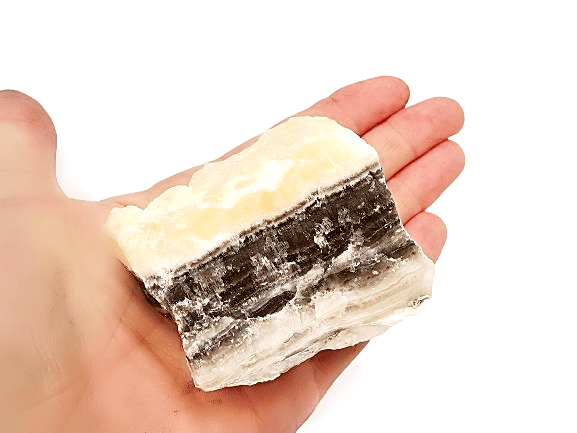
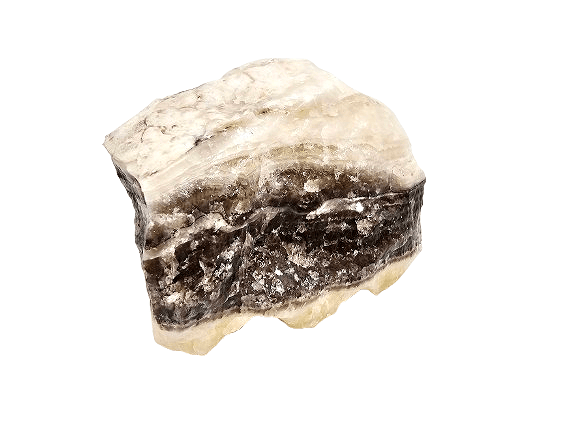




Zebra Calcite Rough B (228g) – Natural Banded Calcite Specimen
Striped, chunky and completely unpolished, this rough Zebra Calcite specimen weighs approximately 228g and measures around 7 × 5cm. The stone gets its memorable trade name from contrasting natural banding that gives the material a zebra-like appearance, while the rough finish keeps its original contours and texture on show.
Zebra Calcite is a trade name used for patterned Calcite material rather than a separate mineral species. Beneath the dramatic name is one of mineralogy’s most fascinating and widespread carbonate minerals — Calcite.
Product Details
- Crystal: Zebra Calcite
- Form: Rough natural specimen
- Weight: Approx. 228g
- Size: Approx. 7 × 5cm
- Finish: Rough / unpolished
- Natural banding, markings and surface texture may vary
- Includes a crystal meaning card
What Is Zebra Calcite?
Zebra Calcite is a descriptive trade name for Calcite material displaying contrasting bands or layers. The underlying mineral is Calcite, a calcium carbonate mineral with the chemical formula CaCO₃.
Calcite occurs in an enormous variety of colours and forms, so names used in the crystal trade often describe a particular appearance rather than a separate mineral species. In Zebra Calcite, it is the striking patterned look that gives the stone its identity.
Calcite Is Softer Than Quartz
Calcite has a Mohs hardness of approximately 3, compared with about 7 for Quartz. That difference matters when handling a rough specimen because Calcite can scratch and chip more readily than many of the harder crystals commonly displayed alongside it.
Its softness is also useful to geologists. Hardness is one of the physical properties used when identifying unknown minerals, alongside features such as crystal form, cleavage and reaction with acid.
Did You Know? Calcite Fizzes in Acid
One of the classic mineral-identification tests for Calcite is surprisingly dramatic: it effervesces, or fizzes, when exposed to dilute acid. The reaction occurs because the carbonate component of Calcite reacts with the acid and releases carbon dioxide gas.
Geologists can use this reaction to help identify carbonate minerals and carbonate-rich rocks such as limestone. It is one of those wonderfully satisfying pieces of geology where a mineral can quite literally bubble its way towards an identification.
There is no need to perform the test on a collector specimen, though — acid can damage Calcite’s surface.
Calcite Has Perfect Rhombohedral Cleavage
Another distinctive feature of Calcite is its cleavage. The mineral can break repeatedly along three directions to produce rhombohedral fragments — slanted, box-like forms rather than ordinary cubes.
This happens because the internal crystal structure contains planes along which the mineral separates more readily. It is a reminder that even when a rough piece looks irregular on the outside, its internal atomic arrangement is highly organised.
Zebra Calcite Meaning & Traditional Associations
Within modern crystal traditions, Calcite is commonly associated with energy, motivation, clarity and movement. Zebra-patterned Calcite is also often linked symbolically with balance, particularly the idea of bringing contrasting energies or different parts of life into greater harmony.
As with other trade-named Calcites, these associations belong to contemporary crystal traditions rather than representing a separate mineralogical property of Zebra Calcite.
Displaying & Caring for Rough Zebra Calcite
At approximately 7 × 5cm, this specimen is a convenient size for a crystal shelf, desk, altar or mineral cabinet. Its contrasting pattern also makes it useful in mixed displays where different textures and mineral structures can be compared.
Because Calcite is relatively soft, store it where harder stones will not repeatedly rub against it. Avoid acids, harsh household cleaners and prolonged soaking. For routine dusting, a soft dry brush is the safest simple option.
Browse our wider Crystals collection for more natural and polished mineral specimens.
Frequently Asked Questions
How large is this Zebra Calcite specimen?
It weighs approximately 228g and measures around 7 × 5cm.
Is this Zebra Calcite polished?
No. This is a rough, unpolished specimen, so the stone retains its natural surface texture and contours.
Is Zebra Calcite a separate mineral?
No. Zebra Calcite is a trade name used for patterned Calcite material. The underlying mineral is Calcite, a form of calcium carbonate.
How hard is Calcite?
Calcite has a Mohs hardness of approximately 3, so it is considerably softer than Quartz and should be handled with care.
What is Zebra Calcite traditionally associated with?
Within modern crystal traditions, Calcite is commonly associated with energy, motivation, clarity and movement, while Zebra Calcite is also popularly connected with balance and harmony.
Does this rough Calcite include a meaning card?
Yes. It includes a crystal meaning card covering the stone’s traditional associations.
Pairs Well With
- Clear Quartz for contrasting hardness and crystal structure
- Black Tourmaline for a strong striped-and-dark display
- Other Calcite varieties for comparing colour and pattern
- Agate for contrasting banded mineral materials
- Other rough collector specimens
Perfect For
- Calcite collectors
- Rough crystal displays
- Fans of naturally banded stones
- Mineral and geology enthusiasts
- Desk, shelf or altar displays
- Anyone who loves crystals with instantly recognisable patterns
With its bold natural banding and surprisingly reactive mineral chemistry, this rough Zebra Calcite is proof that a stone can be visually striking and geologically entertaining at the same time.




Reviews
There are no reviews yet.